Marcus Schmickler, 'Palace of Marvels [queered pitch]' (editionsMego)
Marcus Schmickler
Mar 15, 2014
(8pm)
Performance
Please RSVP
German composer and electronic musician Marcus Schmickler returns to the Graham Foundation on March 15, 2014, for a performance that will explore the correlation between music, language, thought, and representation. Schmickler will present “Semiotic Chora,” a new work that uses sonifications of logical functions and electro-acoustic artifacts.
Marcus Schmickler (b. 1968, Cologne, Germany) studied composition and electronic music and works in both composed and improvised forms. He has won numerous prizes and honors and is closely associated with the Cologne label a-Musik. As a composer, he has worked with the ensemble recherche, the Staatskapelle Weimar, the musikFabrik, the Paragon Ensemble, the Ensemble Zeitkratzer, among others. As a musician, he has performed with artists such as John Tilbury, Thomas Lehn, MIMEO and Julee Cruise. Schmickler lives and works in Cologne.
This performance is presented in partnership with Lampo and with the support from the Goethe-Institut Chicago. Founded in 1997, Lampo is a non-profit organization for experimental music, sound art, and intermedia projects. Visit lampo.org.

Bookshop Event: Children’s Bookmaking Party & Soberscove Press Book Launch
Mar 15, 2014
(2pm)
Other
Please RSVP
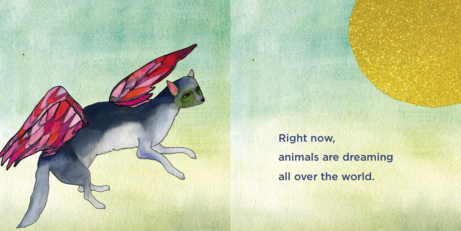
To celebrate the launch of the new Artists’ Board Book series, published by Graham grantee Soberscove Press, the Graham Foundation Bookshop will be hosting a special event for children inside Judy Ledgerwood’s immersive installation, Chromatic Patterns for the Graham Foundation. This innovative series consists of 5 individually-authored books that playfully combine the conventions of the artist’s book with those of children’s board books. On March 15, 2014, children of all ages are invited to create their own board books, finding inspiration in the pattern, color, and ornament of Ledgerwood’s vibrant wall painting and the Foundation’s historic Prairie-style Madlener House. Co-sponsored by Poetry magazine, the launch event will also include an artist-led activity by Jessie Mott, author of Animals Dreaming.
Soberscove's Artists' Board Books are sold individually, as well as in a Limited Edition Boxed Set. Titles include:
Animals Dreaming by Jessie Mott
Dunes at Noons by Brad Tucker
Food Face by Carrie Solomon
Mountain Ocean Sun by David Brainard
A Sunny Day for Flowers by Zehra Khan and Tim Winn
Soberscove Press seeks to make available art-related materials that fill a gap in the literature, are difficult to access, or are created in collaboration with artists. Our publications are intended for a general readership that thrives on intellectual curiosity and visual pleasure.
Jessie Mott is a Chicago-based visual artist and writer whose work employs a menagerie of human, animal, and celestial forms. Mott’s work has been included in many solo and group exhibitions. Her collaborative animations with the artist and writer Steve Reinke have been screened nationally and internationally, and will be presented in the upcoming 2014 Whitney Biennial. Mott received a MFA from Northwestern University and a BFA from New York University.
Founded in Chicago by Harriet Monroe in 1912, POETRY is the oldest monthly devoted to verse in the English-speaking world. Harriet Monroe’s “Open Door” policy, set forth in volume 1 of the magazine, remains the most succinct statement of POETRY’s mission: to print the best poetry written today, in whatever style, genre, or approach. The magazine established its reputation early by publishing the first important poems of T.S. Eliot, Ezra Pound, Marianne Moore, Wallace Stevens, H.D., William Carlos Williams, Carl Sandburg, and other now-classic authors. In succeeding decades it has presented—often for the first time—works by virtually every significant poet of the twentieth century.
Image: from Animals Dreaming by Jessie Mott
Related Links
Learning by Doing at the Farm: Craft, Science, and Counterculture in Modern California (Soberscove Press, 2014)
http://grahamfoundation.org/grantees/5074-learning-by-doing-at-the-farm-craft-science-and-counterculture-in-modern-california
Announcing the 2014 Emerging Visions Competition Winners, Presentation & Reception
Mar 13, 2014
(6pm)
Panel Discussion
Please RSVP
The Chicago Architectural Club, in partnership with the Graham Foundation and AIA Chicago, is pleased to announce the winners of the 2014 Emerging Visions competition:
CHRISTOPHER MARCINKOSKI & ANDREW MODDRELL
PORT Architecture + Urbanism
and
GRANT GIBSON
CAMES/gibson
Please join us tomorrow, March 13, 2014, to celebrate the results of the 2014 competition with special presentations by this year's winners followed by a roundtable discussion with the jury.
This year's jury includes Emerging Visions alumni Michael Wilkinson, Sarah Dunn (UrbanLab), Tristan d'Estree Sterk (ORAMBRA), Karla Sierralta & Brian Strawn (Strawn.Sierralta), and Iker Gil (Mas Studio), as well as AIA Chicago executive vice-president Zurich Esposito, Graham Foundation director Sarah Herda, and prize founders Elva Rubio and Dan Wheeler.
Founded in 1998, the Emerging Visions competition recognizes significant architectural endeavors by promising young architects and designers based in Chicago.
Images: (Top) Christopher Marcinkoski and Andrew Moddrell (PORT Architecture + Urbanism); (Bottom) Grant Gibson, (CAMES/gibson)
Related Links
Chicago Architectural Club
http://chicagoarchitecturalclub.org/
AIA Chicago
https://www.aiachicago.org/
Giving Shape
Zak Kyes
Feb 12, 2014
(6pm)
Talk
Please RSVP
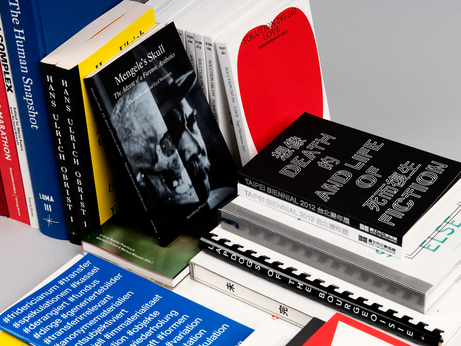
In a new lecture titled “Giving Shape,” Graham grantee Zak Kyes explores historical references that inform his studio’s approach to publications, exhibitions and identities including Lina Bo Bardi, Seth Siegelaub, CalArts and the Visual Design Association, while also showing the studio’s recent and ongoing projects with the Architectural Association, Haus der Kulturen der Welt, 2012 Taipei Biennial, Lisbon Architecture Triennale, Fridericianum, and 8th Berlin Biennale. Zak Group uses the strengths and skills that come from graphic design to consider how designers can thoughtfully take part in the creative process where giving shape is its own way of creating culture.
First presented November 2013 at Centre Pompidou, Paris
Zak Kyes is a Swiss-American graphic designer and founder and director of the design studio Zak Group. Since 2006 Kyes has been the art director of the Architectural Association, London. In 2008, he co-founded Bedford Press, an imprint of AA Publications. Apart from studio projects, Kyes's critical practice encompasses publishing, curating, and site-specific projects. His current projects include the art direction of the 8th edition of the Berlin Biennale (2014). Kyes also teaches at the Architectural Association School of Architecture, London, and at ECAL (Ecole Cantonale d'Art de Lausanne).
Zak Group is a London-based design studio headed by Zak Kyes and Grégory Ambos. The office was formed in 2005 as a collaborative practice to explore the possibilities for design in the production of culture. The studio received the Inform Award for Conceptual Design in 2011 and was twice awarded the prize for the Most Beautiful Swiss Book in 2010. The studio's work has been included in the exhibitions Graphic Design Worlds (Triennale Design Museum, Milan, 2011), Wide White Space (CCA Wattis, San Francisco, 2011), The Malady of Writing (MACBA, Barcelona, 2009), Graphic Design for and Against Cities (Corner College, Zurich, 2009), and the 22nd International Biennale of Graphic Design (Brno, 2009).
Image: Brotherton—Lock, 2013. Courtesy Zak Group.
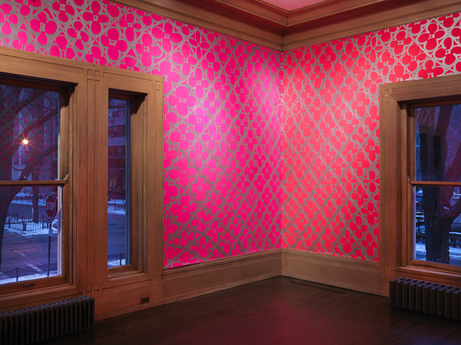
View of “Judy Ledgerwood: Chromatic Patterns for the Graham Foundation,” 2014, Graham Foundation, Chicago. Photo Tom Van Eynde.
Judy Ledgerwood
Feb 06, 2014
(6pm)
Talk
Please RSVP
On February 6, 2014, Judy Ledgerwood will discuss her practice and her current installation, Chromatic Patterns for the Graham Foundation, on view through April 5, 2014.
Judy Ledgerwood is a Chicago-based painter and educator. She is the recipient of numerous awards including The Richard H. Driehaus Foundation Award, an Artadia Award, a Tiffany Award in the Visual Arts, a National Endowment for the Arts Award, and an Illinois Art Council Award. Her work is represented in public collections including the Art Institute of Chicago, the Metropolitan Museum of Art, the Museum of Contemporary Art Los Angeles, the Milwaukee Museum of Art, the Museum of Contemporary Art Chicago, and the Kunstmuseum St. Gallen Switzerland. She received a BFA from the Art Academy of Cincinnati and a MFA the School of the Art Institute of Chicago. Ledgerwood is Director of Graduate Studies and Professor of Art Theory and Practice at Northwestern University.
For more information on the exhibition, Chromatic Patterns for the Graham Foundation, click here.



 PREVIOUS POSTS